Our Patron
Venerable Emil J. Kapaun
Catholic Priest · U.S. Army Chaplain · 1916 — 1951
Cause for Sainthood Advanced · 2025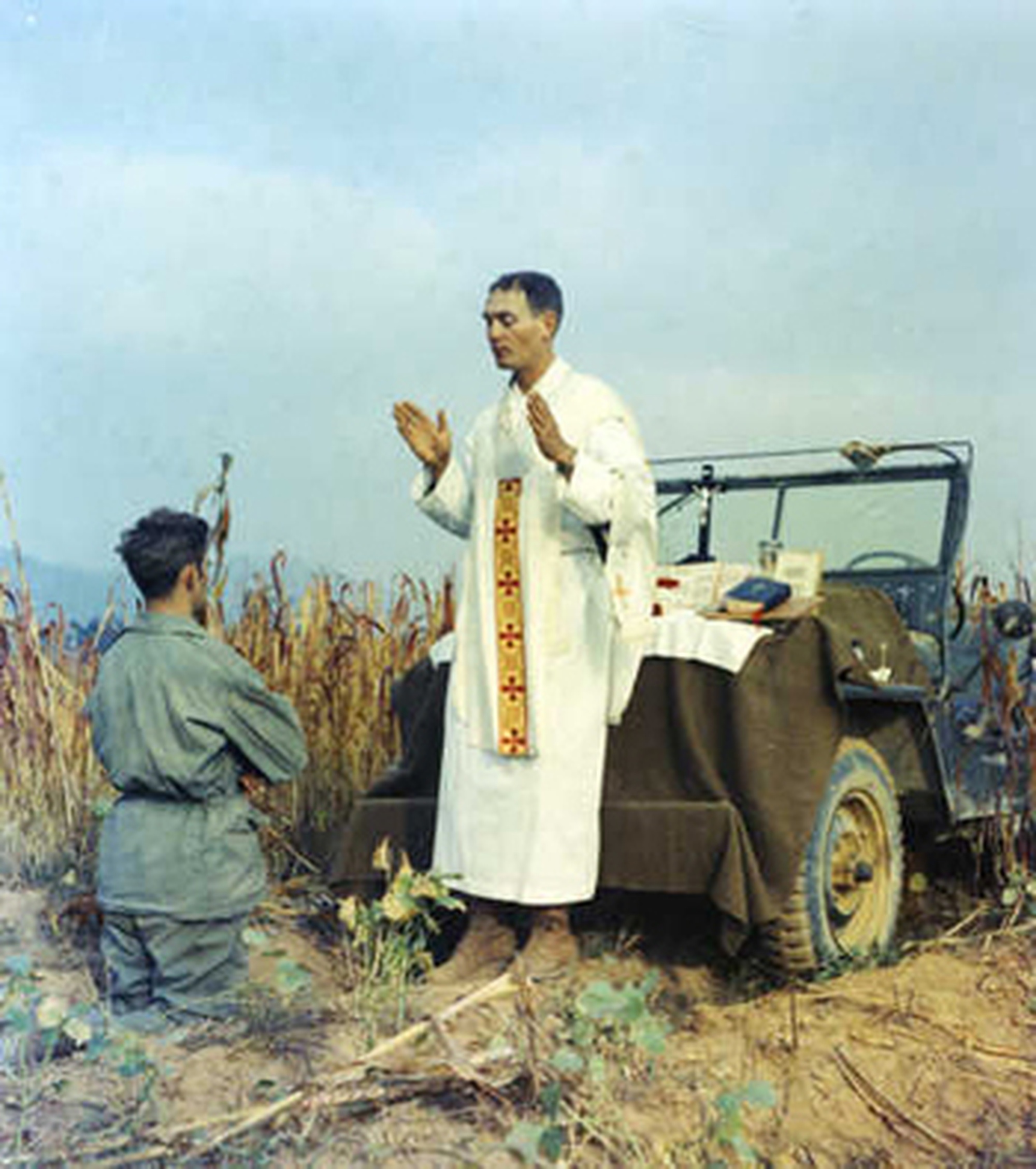
Photo by Col. Raymond Skeehan · U.S. Army · Public domain
Catholic Priest · U.S. Army Chaplain · 1916 — 1951
Cause for Sainthood Advanced · 2025
Troop 3 carries his name. Kapaun's Boys are sons being formed into the kind of men he was — fathers leading them by the same example he gave: faithful, steady, ready when the fire comes.
This page is for his story. Read it. Listen to it. Pass it on.
Emil Joseph Kapaun was born on Holy Thursday, April 20, 1916, in the small Czech farming community of Pilsen, Kansas — about ninety miles south of Atchison. His parents were immigrants. His childhood was hands and dirt and the slow rhythms of a parish that knew everyone by name.
He felt the call to the priesthood early. After seminary, he was ordained in June 1940 at Sacred Heart College in Wichita — the first man from Pilsen to enter the priesthood for the Diocese of Wichita. He served his hometown parish for a few years, then answered the call for chaplains during World War II and joined the Army Chaplain Corps in 1944. He served in Burma and India, came home in 1946, finished a master's degree, and re-entered the Army in 1948 — drawn back to soldiers who needed a priest in the field.
In July 1950, just weeks after Communist North Korea invaded the South, Chaplain Kapaun was among the first American troops sent in. He racked up two thousand miles a month on his jeep, saying Mass on its hood, hearing confession in foxholes, anointing the wounded under fire. In a letter home to his bishop he wrote, simply, "Tomorrow we are going into combat."
On November 2, 1950, at the Battle of Unsan, his unit was overrun by Chinese forces. Kapaun had a chance to fall back to safety. He refused. He stayed with the wounded who couldn't be evacuated, knowing it meant capture. When a Chinese soldier raised a rifle to execute a wounded American, Kapaun pushed the soldier aside and carried the man out himself.
What followed was a death march of nearly a hundred miles through the Korean mountains in winter, then seven months in the prison camp at Pyoktong. He stole food for the starving. He washed the lice-ridden clothes of men too weak to do it themselves. He led prayer in defiance of the camp's communist indoctrination. He encouraged. He forgave. He became the spiritual father of that camp.
By spring 1951 he was sick — a blood clot in his leg, then dysentery, then pneumonia. The Chinese guards, who had grown to resent his influence over the prisoners, denied him medical care. His fellow soldiers carried him on a stretcher to what the camp called the "death house," and along the way Kapaun asked them to stop so he could ask forgiveness from each of the guards he passed and bless them. He died on May 23, 1951. He was 35 years old.
His remains were unaccounted for nearly seventy years. In 2021, after decades of work by the Defense POW/MIA Accounting Agency, his body was identified and returned to Kansas. Today he rests in the Cathedral of the Immaculate Conception in Wichita.
The Merry Beggars, the audio drama division of Relevant Radio, produced a five-episode dramatization of Father Kapaun's life as part of their Saints series. It's free, well-acted, and endorsed by Scott Carter — the Diocese of Wichita's advocate for Father Kapaun's canonization.
It's aimed at ages 9 and up, but parents of younger cadets may want to listen first.
Southeast Asia, 1945. A young Kansas priest finds himself in the closing days of World War II.
After Unsan, Father Emil and his companions are forced through the freezing Korean mountains toward Pyoktong.
Lord Jesus, in the midst of the folly of war, your servant, Chaplain Emil Kapaun, spent himself in total service to you on the battlefields and in the prison camps of Korea, until his death at the hands of his captors.
We now ask you, Lord Jesus, if it be your will, to make known to all the world the holiness of Chaplain Kapaun and the glory of his complete sacrifice for you by signs of miracles and peace.
In your name, Lord, we ask, for you are the source of peace, the strength of our service to others, and our final hope.
Amen.
Chaplain Kapaun, pray for us.
Official prayer of the Father Kapaun Guild,
Catholic Diocese of Wichita
For acts of gallantry and intrepidity at the risk of his own life, above and beyond the call of duty: Chaplain Emil J. Kapaun distinguished himself by extraordinary heroism while serving with the 3rd Battalion, 8th Cavalry Regiment, 1st Cavalry Division during combat operations against an armed enemy at Unsan, Korea, from November 1–2, 1950. On the morning of November 2, after Chinese forces viciously attacked friendly elements, Chaplain Kapaun calmly walked through withering enemy fire in order to provide comfort and medical aid to his comrades and rescue friendly wounded from no-man's-land. As Chinese forces closed in, he braved enemy fire to drag wounded men to safety. When his unit was overrun, he chose to stay behind with the wounded rather than escape — knowing that his decision meant capture or death.
— excerpted from the official Medal of Honor citation
Each year at the beginning of summer, hundreds of pilgrims walk sixty miles across the Kansas plains — from the Church of the Magdalen in Wichita to Father Kapaun's hometown of Pilsen. Four days. Open prairie. The pilgrimage ends with Mass at the church where he was baptized, ordained, and said his first Mass.
It's about ninety minutes south of us. The 2026 pilgrimage runs June 4–7.
The Diocese of Wichita's complete biography — from Pilsen to Pyoktong.
The path to canonization, the 2025 decree, and how to pray for it.
The brotherhood of Catholic men who follow Father Kapaun's example of servant leadership.
The 2021 return of his remains to Kansas after seventy years.
The full five-episode audio drama, with episode-by-episode summaries.
The official Father Kapaun shop — sales support his cause.